What you get
What a painting job leaves you holding
Most of what separates one repaint from another is invisible by the time the paint is on. So the things below are the parts you can read, compare, ask to see, and check at the end — the parts that survive after the van has gone.
You get a document
A list of surfaces, named by location
The hardest thing about a painting bid is that you cannot see what is inside it. A figure covers the whole house and tells you nothing about which parts of it. So the scope is a written list instead — north siding, garage trim, the two soffits over the deck — with product and sheen named per surface. You can read it before anything is opened, and you can hold two of them side by side and see where they differ.
You get a comparison
Prep priced on its own line
Two bids on the same house can be twice apart, and the gap is almost always prep — the hours nobody can see once the paint is on. When prep sits on its own line rather than folded into one number, the part that decides whether the coat lasts is the part you can actually compare. A condition found once the old coat is off becomes another line on the same document, priced on its own.
You get a number to ask for
A meter reading before primer
Everyone says a coat will last. Under 12 percent on a moisture meter is the reading that lets primer go onto bare wood, and above it the wood is still drying. A film sealed over wet wood is why a coat lifts in the first wet season rather than the fifth. It is a number, it is taken on your wall, and you can ask to see it.
You get your house back each evening
Covered before, swept after
The part of a repaint you actually live through is the mess. Plants, beds, concrete, walkways, glass and hardware are covered or taken off before a lid comes off, and covers over planting come back off at the end of the day rather than sitting overnight. Drop cloths up, ladders down, walkways swept — the pack-down belongs to each working day, not to the end of the job.
You get an ending you can check
A final walk against the same list
A job is finished when the list it started from is satisfied, not when the van leaves. The walk at the end runs down the same document as the walk at the start, surface by surface, which is what makes the ending checkable rather than a matter of opinion.
You get one person
The walk, the scope and the ladder are the same hands
The question behind most of the others is who is actually going to be in your house. The person who walks it with you is the person who writes the scope and the person on the ladder, and the one who answers while the work is running. A question about a surface goes to whoever decided about that surface — nothing is relayed through somebody who was not on the walk.
What turns up in the van
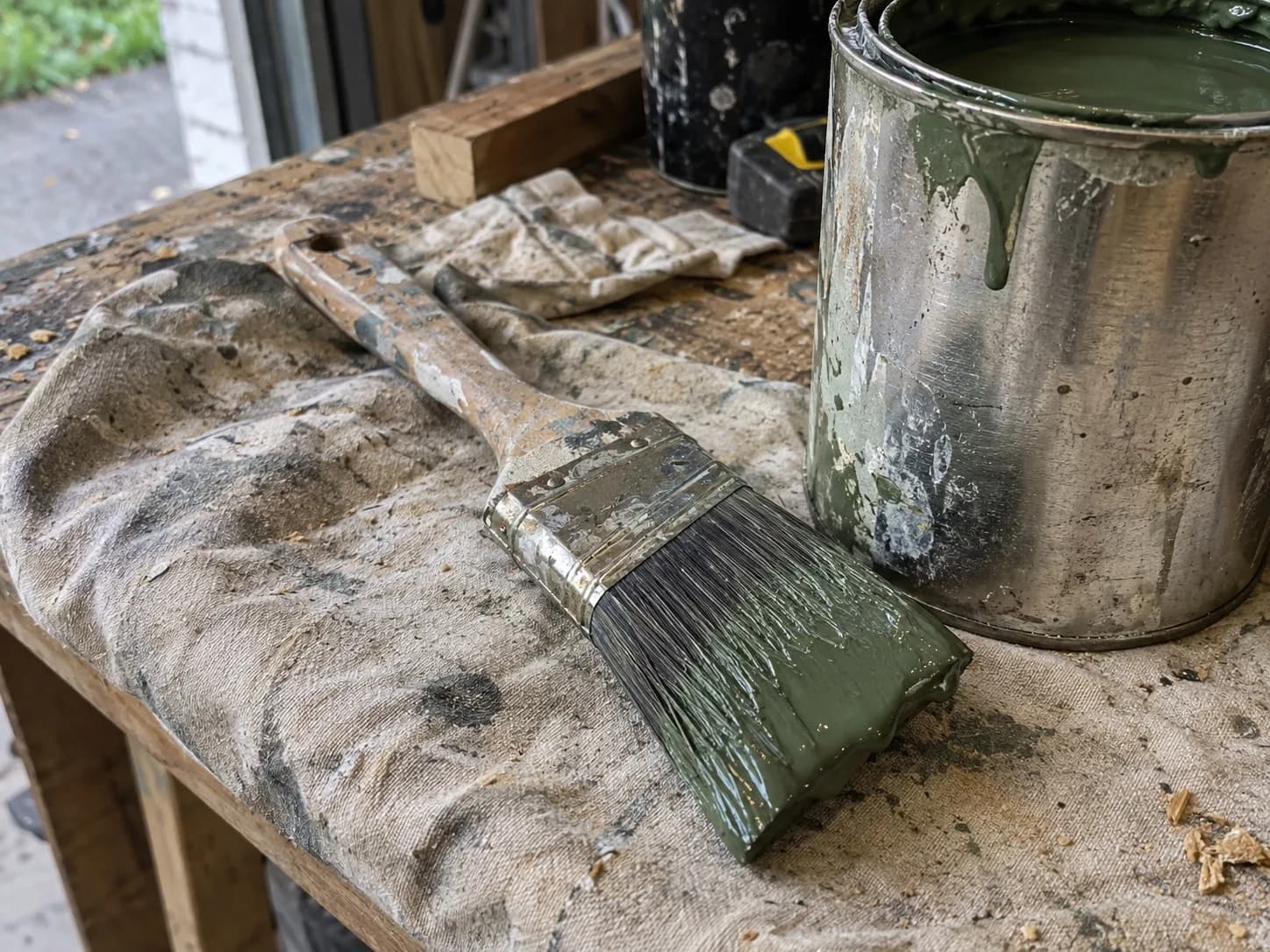
Drop cloths before anything is opened, a brush kept clean enough to cut a line with, and a tin that gets closed at the end of the day. The kit is unremarkable. Using it the same way on every house is the part that shows up in the finish.
Where the lines are
The limits, and what each one buys you
A limit is only worth stating when keeping it costs something. Each of these moves a day, and each one exists because the alternative shows up on your wall a season or two later.
Drizzle and damp siding stop exterior work
A coat has to form a film before it can shed water, and moisture caught underneath is what pushes paint back off the wood. The day moves instead — interior rooms, cabinets, scraping and sanding under cover, masking for the next dry window. The schedule is the variable, not the finish.
Soft wood does not take a coat over it
Paint over rot hides it and buys a season. Soft wood is found, marked, and shown to you before anything covers it, and it goes onto the written scope as its own line — so the decision is yours, made with the wood in front of you rather than after it is out of sight.
An unwashed surface does not take a coat either
Chalk, mildew and road film break the bond between the old coat and the new one, so the new film is holding onto the dirt rather than the wall. Washing is prep, and it is counted as prep on the scope rather than absorbed somewhere as a courtesy.
Hardware that comes off is not masked around
Handles, plates, hinges and switch covers come off and are bagged and labelled to where they belong. Cutting around hardware is how a crisp line turns into a wobble you notice for years, and the minutes it takes to remove a plate are shorter than the minutes it takes to cut around one.
Service area
Where the work happens
Bellevue, Kirkland, Redmond, Sammamish, and Renton. Houses inside that list get walked, scoped, and painted by the same person; a job outside it does not.
Tell us what needs painting
Describe the surfaces you want painted and their current condition.
Request an estimate