Cabinets
Kitchen cabinet painting and refinishing
Serving Bellevue, Kirkland, Redmond, Sammamish, and Renton.
Cabinet paint fails in one place and for one reason: the film never bonded to what was under it. The whole job is the order the steps happen in, and the order is not negotiable.
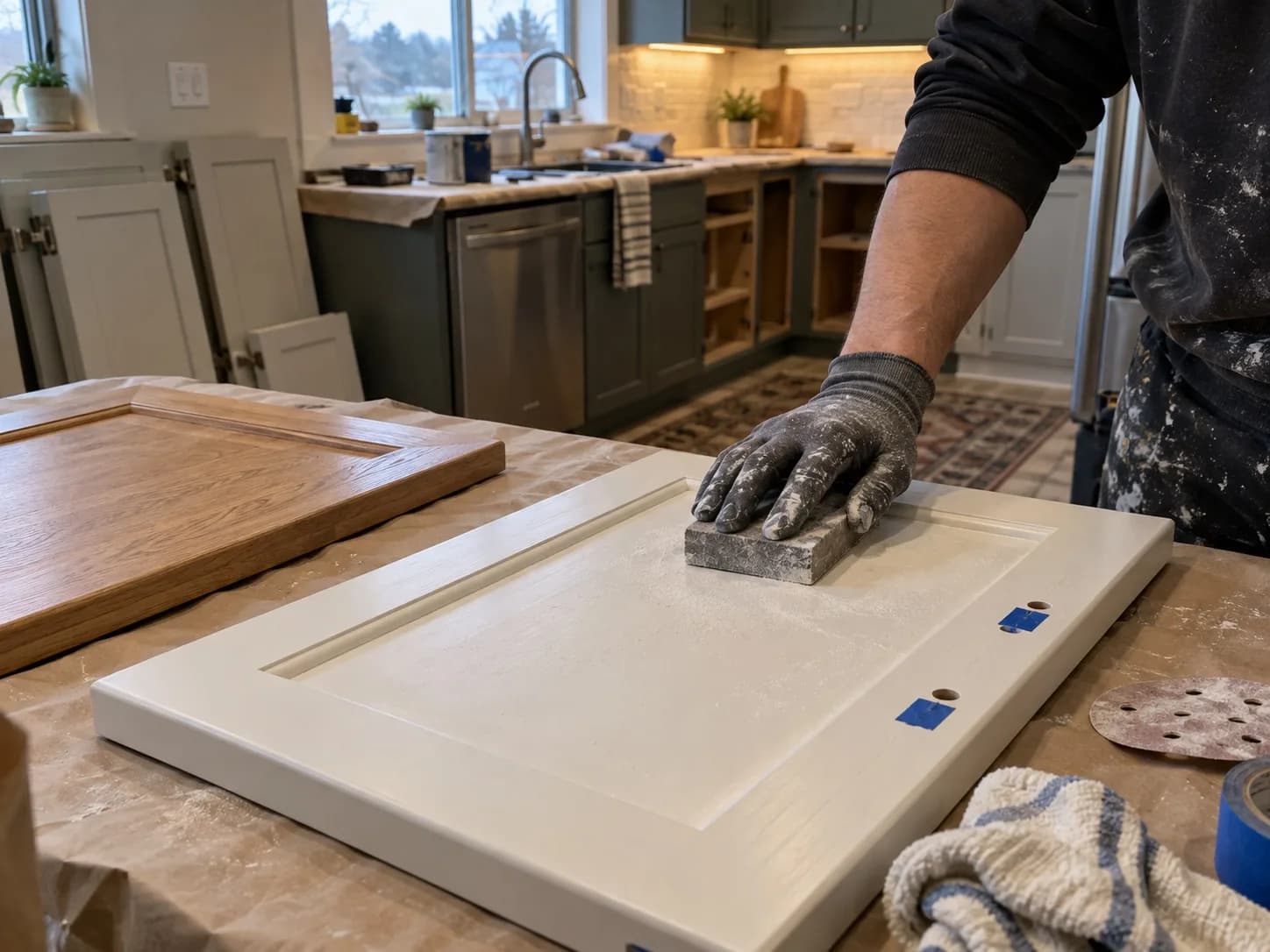
Doors and drawer fronts come off, and each one is labelled to its opening
Labelling is the first step because it is what makes the last one possible: every door, every drawer front, every hinge and every screw carries the mark of the opening it came out of, so what goes back on is what came off. That sounds like tidiness and is not: a kitchen settles over years, hinges get adjusted to the gap they sit in, and doors that look identical stop being interchangeable. Swap two and you spend an afternoon chasing reveals that used to line up.
Hardware goes into bags marked the same way. Hinges are kept with their door rather than pooled in one box, and anything that is being reused comes back to the hole it was screwed into.
The boxes and face frames stay where they are, and get the same sequence as the doors — cleaned, scuffed, primed, and finished to match. Nothing is coated with the doors hanging on it.
Degreasing happens before sanding, not after
This one line is the difference between a finish that stays attached to the door and one that is peeling at the handle edges by next winter.
Cooking oil does not sit on a cabinet door, it soaks into the finish — heaviest on the doors either side of the range, above the cooktop, and around the dishwasher, where steam carries it. Sand a greasy door first and the abrasive drives that oil deeper, straight into the fresh scratch pattern that was supposed to give the primer something to grip. The surface then looks perfect and is contaminated: primer bonds to a film of grease instead of to the door, and grease holds nothing. Paint applied over it comes away later in sheets, taking the primer with it, usually starting where hands touch.
So the order is: clean first, with a cleaner rated for cutting grease, working the profiles and the edges where hands land. Then rinse, because degreaser residue left on a door stops a primer bonding just as effectively as the grease did. Then let it dry. Only then does abrasive touch anything.
Scuff-sand, bonding primer, sprayed finish
Scuff-sanding is not stripping. The aim is tooth, not bare wood: a uniform dulling across the whole face, worked into the profiles and the inside edges of panels, where a machine cannot reach and a hand can. A door that still has shine anywhere has a spot the primer will let go of first. Then all the dust comes off, because dust under primer is the same problem as grease under primer.
The primer is a bonding primer, made to grip a slick factory finish rather than a porous one. On stained wood it also blocks the colour and resin that would otherwise push up through a pale topcoat as a yellow cast. It is sanded lightly once it is hard, so what the finish lands on is flat.
The finish coats are sprayed rather than brushed. On a door face — a wide flat panel that catches light across its whole width — brush texture is visible from across the room, and it collects grease in the ridges afterwards. Sprayed coats go on thin, level out as they set, and get built up in several passes with the doors lying flat, so the film hardens even instead of sagging at the bottom rail.
Dry in hours, hard in weeks
A cabinet finish is dry to the touch in hours and can be recoated after the interval printed on the can. Curing is a different clock: the film keeps hardening for weeks after that, and the last of that hardness is what lets a door take a fingernail, a pan handle, and a cleaning cloth without marking.
Doors go back on before the film is fully cured, because leaving a kitchen without doors for weeks is worse than the care the first stretch asks for. What that care is, exactly: close them gently instead of letting them swing shut, wipe marks with a damp cloth rather than a spray cleaner, and keep things from resting against a face under pressure. Two coated surfaces pressed together while still curing can stick to each other and tear when they part, which is why bumpers on doors and drawer fronts matter more in the first weeks than they ever will again.
Heat and humidity change all of it. A kitchen running a kettle and a dishwasher through a wet week cures slower than the same kitchen in dry weather, and the interior doors of a cabinet, in still air, are slower still.
Cabinet questions
Why does painted cabinet work peel off in sheets?
Almost always because sanding happened before degreasing. Cooking oil is in the old finish, sanding presses it into the scratch pattern, and the primer then bonds to grease rather than to the door. The failure shows up first where hands touch — handle edges, the doors beside the range — and it lifts in sheets rather than flaking, because the whole film is sitting on a layer that was never attached.
The other common cause is a topcoat over a glossy factory finish with no scuff and no bonding primer. Slick and clean is still slick.
Can the doors stay on?
No. A door hanging in its opening cannot be cleaned into the profile corners, cannot be coated on its edges and sides, and cannot lie flat while the film sets, so it sags at the bottom rail. Hinges also end up coated, which changes how the door closes for the rest of its life. Taking them off is the step that makes the other steps possible.
Our cabinets are oak. What will the grain do?
It stays visible. Oak is open-grained, and paint follows the grain rather than filling it, so the finish reads as fine lines across the panel — more obvious in a pale colour and in a flatter sheen. It can be reduced by grain filling before primer, which is a separate step and considerably more hours. Worth deciding at the walkthrough, with a door in front of you, rather than after the first coat.
How long is the kitchen out of use?
That belongs in the written scope for your kitchen, not on a page like this one — it moves with the number of doors and drawer fronts, whether the boxes are being done, how the weather is running, and the dry and recoat intervals printed on the can. What is fixed is the shape: the boxes and the counters stay in use throughout, the doors return to the openings they were labelled to, and the finish keeps hardening for weeks after they are hung.
How do we clean them afterwards?
A damp cloth, and a drop of dish soap where cooking film builds up near the range. What to keep away from them: spray kitchen cleaners with solvents or degreasers in them, abrasive pads, and anything sold as a scrub. Those dull the sheen in patches, and on a film still curing they can lift it.
Tell us about your kitchen cabinets
Describe the doors, drawer fronts, and cabinet frames you want refinished. Working in Bellevue, Kirkland, Redmond, Sammamish, and Renton.