Exterior
Exterior house painting
Serving Bellevue, Kirkland, Redmond, Sammamish, and Renton.
Prep is most of the hours, and prep is what decides whether the coat is still on the wall after a wet winter. Everything below is something you can stand in the driveway and check.
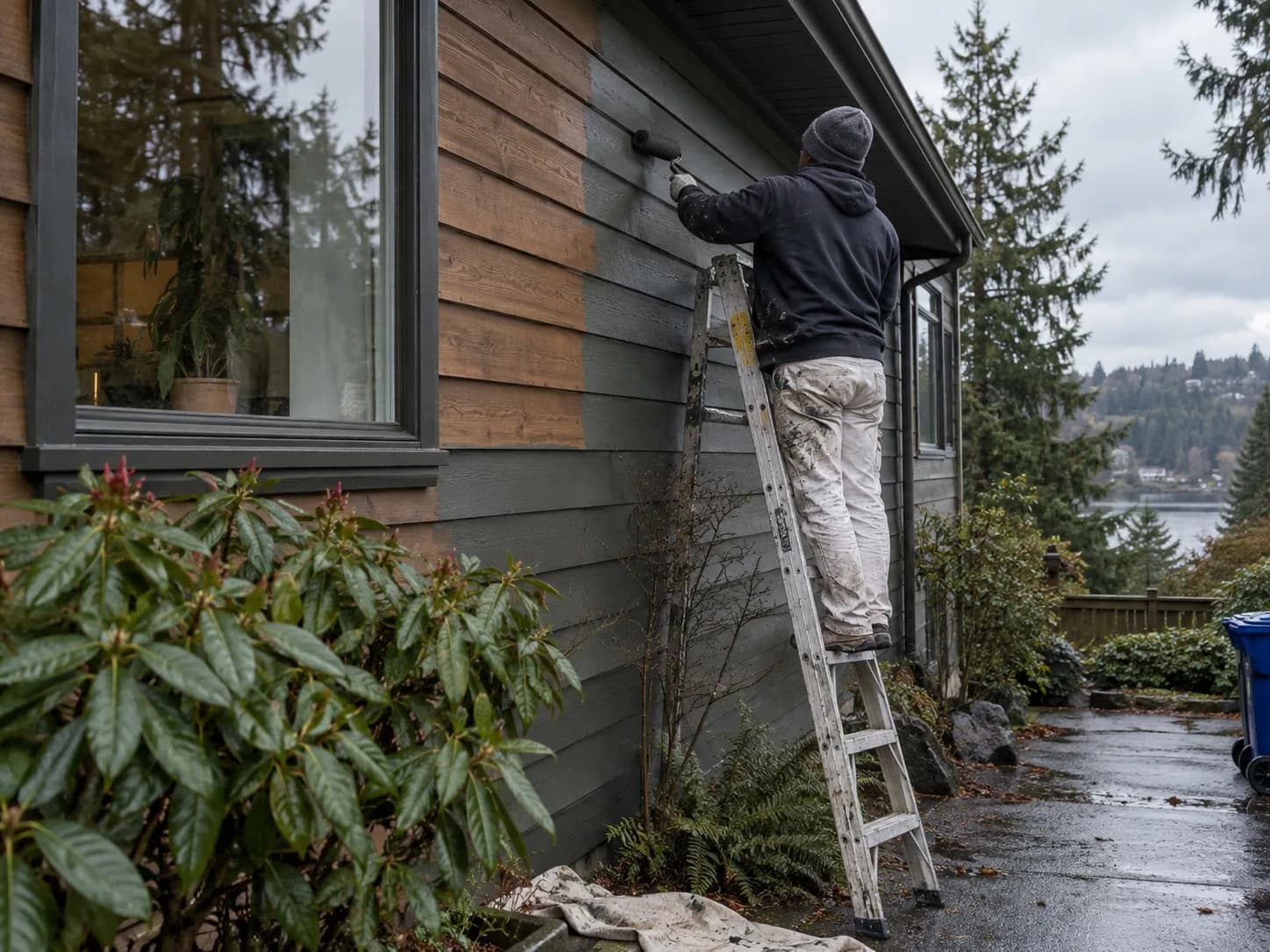
Drizzle stops exterior work
It is the condition that moves a start date more often than any other. An exterior coating forms its film as water leaves it, so three things have to hold at once: the surface is dry going in, the air and surface temperature stay inside the range printed on the can, and the surface sits at least 5°F above the dew point through the dry time.
That last one is the one that catches people. The sky can be clear at four in the afternoon and the wall can still be condensing at seven, which puts water onto a film that has not closed. Rain on an uncured coat washes binder out of it — that chalky, streaked look on a wall painted a day too early. Paint over damp siding and the moisture is sealed behind the film, then pushes back out as blisters and peeling.
So some days are not paintable outdoors, and what says so is a reading rather than a mood. Those days go indoors or under cover: interior rooms, cabinets, scraping and sanding, masking, or setting up for the next dry window. A wet week is a week of prep rather than a week of nothing.
Cedar, and houses that have been standing a while
Cedar moves with the weather and it feeds on water from whichever side can reach it. A board coated on the face only is a board that drinks from behind, and the coat comes off in sheets while looking sound from the ground. So new and replaced boards are back-primed — primed on all six sides, including the ends and the back, before they go up. It is invisible work that decides how the wall behaves in year three.
Cedar also carries tannin, which travels through a water-based coat and comes up as brown staining over knots and grain. That is answered with a stain-blocking primer chosen for the wood, not with an extra finish coat over the top of the bleed.
On the north side the same wall behaves differently. It gets little direct sun, dries slowest, and grows black mildew and moss because moisture sits against it around the clock. Both come off in the wash stage above; what makes this elevation its own problem is what they leave behind. Moss is a water problem before it is a paint problem — it holds damp against the boards around the clock, which is why the wall behind it is the one most likely to hide soft wood.
Then the waiting. Washing puts water into wood that is already slow to give it up, and a north wall regularly needs extra days to come back under 12 percent. The meter, not the calendar, says when it is ready.
When soft wood turns up
On a house of any age it turns up. It collects where water stands or runs: the bottoms of trim boards, window sills and their end grain, the underside of horizontal joints, corner boards near grade, and the run below a gutter that overflows. Scraping is how it gets found, because soft wood does not announce itself from the ground.
What follows is fixed and short. Found, marked, photographed, named. The mark goes on the board where it is visible from the ground, the photo goes with it, and the board is named by location on the same written list the rest of the job runs on — the same document, not a remark at the end of a day.
That board then carries two lines: what it is, and what is being done about it. The second is a decision made with the wood in front of you, written down before it is acted on. Filler and a coat over the top is not one of the options. Painting over soft wood hides it. It does not stop it, and the next person to find it is finding it after it has spread.
The prep sequence
In the order it happens on the wall. Nothing here is optional, and nothing here is faster on a hot week.
Wash the house, then wait
Dirt and chalk come off first, because a coat over chalk sits on dust instead of wood. Mildew is cleaned with a solution rated for it, scrubbed where the growth is heavy, and rinsed until no residue is left behind. A washed wall is not a dry wall: what follows the wash is waiting.
Back to a sound edge
Loose paint comes off until what remains will not lift under a blade. The scrape line is then feather-sanded so the step disappears under the coat instead of telegraphing through it. This is where the hours go, and it is the last stage still open to inspection before colour covers it.
The wood gets read before primer
A moisture meter goes on the bare wood. Under 12 percent and primer can go on; over it, the primer waits, however good the sky looks. Sealing water inside a board is what produces blisters two seasons later, and it is not visible on the day it happens.
Close the joints that should close, leave the ones that should not
Seams that opened over the winter get re-caulked, along with trim edges and the places two materials meet. The vertical butt joints in siding are left open on purpose, so water that gets behind the boards has a way back out.
Spot-prime the day the wood is exposed, then two coats
Raw wood left open drinks rain, so bare spots are primed the same day they are made. Two coats go on the finished surfaces, and the cut lines where siding meets trim are brushed by hand rather than taped and hoped for.
Exterior questions
Will it last in the rain?
It lasts when it went onto a surface that was dry, clean, and sound — all of which is settled before the finish coat, not by it. A coat comes off early for a small number of physical reasons: it went onto a damp surface and sealed water behind itself, it was rained on before the film closed, it went over chalk or mildew instead of clean wood, or it went over a scrape line that was never feather-sanded flat.
So the answer is a set of readings rather than a promise: bare wood under 12 percent before primer, surface at least 5°F above the dew point through dry time, temperature inside the can’s range, back-primed boards where new wood goes up, and two coats.
The north wall is where a failure shows first. It is also the wall that gets the longest wait after washing, for the same reason.
There is moss and black mildew on the north wall. Can it be painted over?
No, it has to come off first. Mildew is alive, and a film laid over it is grown through within a season. The cost is in the waiting rather than the washing: wet wood dries slowest on the wall that grew the mildew, so a north elevation usually sits for extra days before the meter reads under 12 percent.
What happens if you find rot?
Rot goes onto the written list as its own line, with a photo and the board named by location.
Scraping is what finds it, because soft wood does not announce itself from the ground, so it turns up during prep rather than at the end of a day. What happens to that board is a second line on the same list, decided with the wood in front of you and written down before it is acted on. Until that line is settled the board is not painted, because filler and a coat over soft wood hide it rather than stop it.
How long after washing can you paint?
As long as it takes the bare wood to read under 12 percent on the meter — sometimes later the same day, sometimes days after. A sunny south wall comes back quickly; a shaded north wall after a wet week takes far longer, and the reading has to be taken on the wall being coated rather than on the easiest wall to reach.
Which paint goes on my house?
It is written into the scope by surface — product and sheen per surface, not the word “paint” for the whole house. Siding, trim, soffits, and metal do not take the same coating, and a north elevation and a sun-beaten south elevation are not the same exposure. The names sit on paper ahead of the work, which is what makes what ends up on the wall checkable against what was agreed.
Tell us which exterior surfaces need painting
An exterior scope names the surfaces one by one, names the exclusions the same way, and puts prep on its own line. Working in Bellevue, Kirkland, Redmond, Sammamish, and Renton.