Interior
Interior house painting
Serving Bellevue, Kirkland, Redmond, Sammamish, and Renton.
A bedroom over a weekend is a job a homeowner can do well, and plenty do. This page is about the rooms where that stops being true, and about what the day looks like when someone else is doing it.
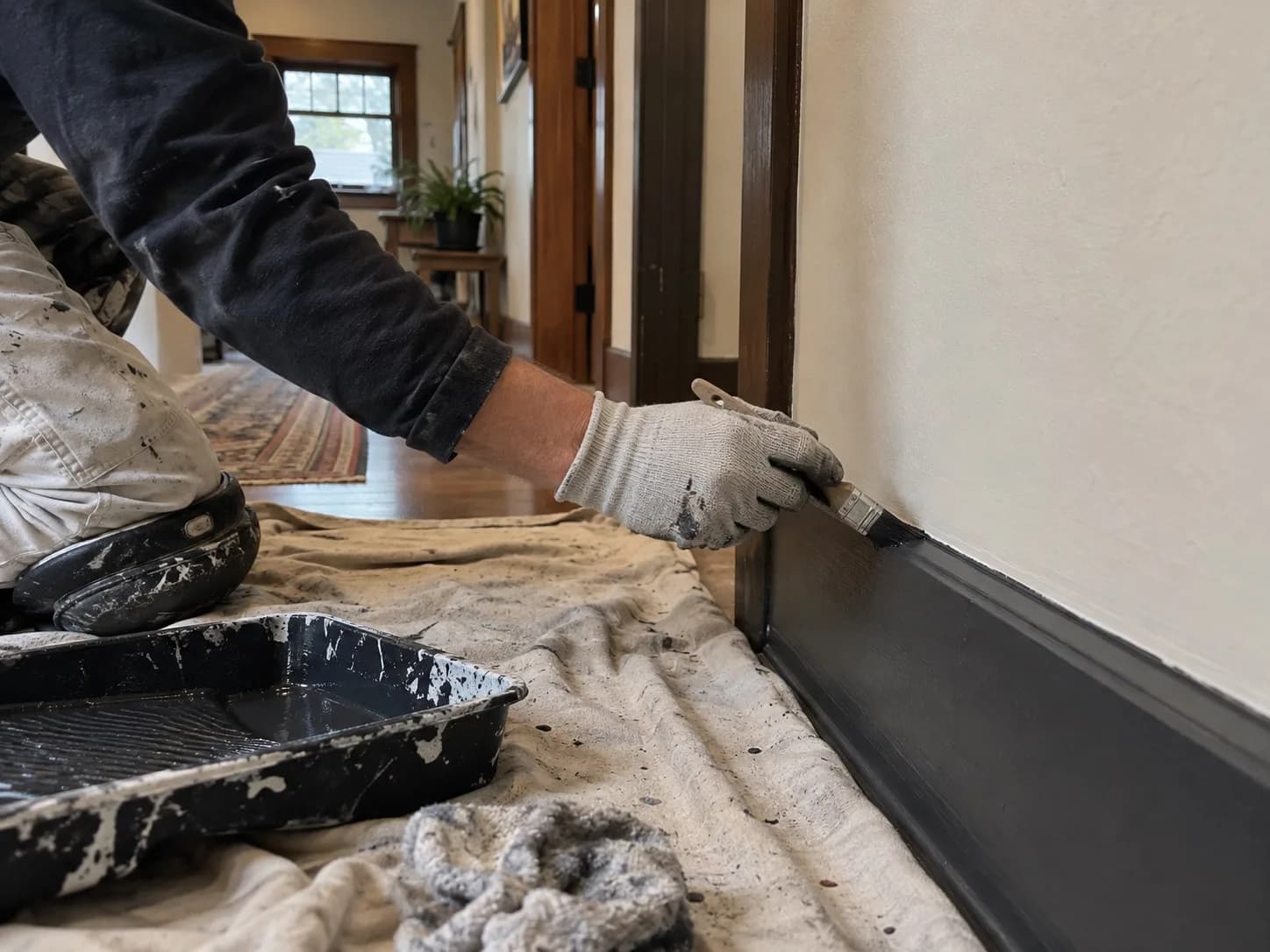
When it is worth having someone else do it
Four things change the answer, and none of them is skill with a roller.
Height, and stairwells in particular. A stairwell wall runs to the upper ceiling, and the floor under it is a staircase, so a ladder has nothing level to stand on. That wall is planks and staging, not a step stool, and it is the one interior surface where the risk is a fall rather than a bad line. Two-storey entries and vaulted ceilings are the same problem in a different shape.
Volume against a timeline. One room is a weekend. A whole floor is a sequence: mask, fill, sand, prime, cut, coat, re-hang, move on — run in an order that keeps the house usable each evening instead of half-apart for a month. The difficulty is in the sequence, not in any single room.
Dust. Sanding filler and old trim makes dust fine enough to travel to rooms nobody is working in. Keeping it in one room is doorway plastic, closed returns, and sanding connected to a vacuum — setup work that costs more time than the sanding does.
Trim with a lot of shape. Crown, panelled doors, coffered ceilings, and stained wood that is going white are slow by nature: more edges, more cut lines, and a primer step that cannot be skipped. This is where a room stops being a weekend and starts being a week.
What happens before anything is opened
Furniture is moved to the middle of the room and covered, and the floor is covered wall to wall rather than in a walking strip — drops on the traffic path with the edges taped down, so a cloth cannot slide underfoot and a heel cannot carry a footprint into the hall. Carpet edges get taped at the baseboard. Doorways to rooms that are not being painted get closed off, and heating returns in the work area get covered before any sanding, because a return will move dust through the whole house in an afternoon.
Switch plates, outlet covers, and door hardware come off, and go into a bag labelled to the room they came from. Painting around a plate leaves a ridge you feel with a fingertip and see for as long as you own the house; painting over a hinge leaves a hinge that does not close the same way afterwards.
Tape goes where tape earns its keep — carpet edges, hardware that stays, glass. It does not go where a brush does the job better, which is most of the room.
Filling, sanding, and the lines that get brushed by hand
Nail holes, dents, and the gouge behind the door get filled, then sanded flat rather than sanded smooth — a filled spot that is proud of the wall reads as a shadow under a lamp at night even when it is invisible at noon. Filler is porous, so the repairs get spot-primed; without that, they drink the finish coat and flash back as dull patches in a sheen wall.
Where wall meets ceiling and wall meets trim, the line is brushed by hand. Tape on textured drywall or old trim does two things badly: it lets paint creep under the edge, and it lifts a fine ridge when it comes off. A brushed cut line is one crisp edge that follows the wall as the wall actually runs, which in an older house is not a straight line.
Then two coats. Colour changes and patched walls need the second coat to sit evenly, and a single heavy coat is the reason a wall looks fine at handover and blotchy in low winter sun.
Low odour, and when the room is yours again
Interior work is water-based, and low-odour, low-VOC products are what a bedroom, a nursery, or any room somebody sleeps in the same night calls for. Worth being exact about what that changes: it changes how much the room smells while the water leaves the film. It does not change how long the film takes to harden.
Dry and cured are two different things. Dry to the touch and ready to recoat are both printed on the can, in hours, and both depend on how warm and how humid the room is. Cure is the film finishing its hardening, and it keeps going for weeks after the room looks done. Everything awkward about fresh paint — a chair back printing into a wall, tape lifting a strip off new trim, a cleaner leaving a dull mark — happens in the gap between the two.
Ventilation is what shortens the smell: windows open on two sides if the room has them, and a fan in the window blowing out rather than in, so air leaves the room instead of pushing around inside it. A room aired that way is usually a room you can sleep in that night. Bathrooms and kitchens are the slowest, because humidity keeps water in the film.
Interior questions
Honestly, should I just paint it myself?
Yes — for one room at normal ceiling height, on your own schedule, with flat walls and simple trim, the result can be as good as anyone’s. Most of what separates a painted room from a well painted room is patience during prep, and patience is not something you have to hire.
It changes when the wall is above a staircase, when the ceiling is out of ladder range, when several rooms have to be finished against a date, or when the trim has profiles or a stained finish going to paint. Those are the jobs where the cost of doing it twice is higher than the cost of the first go.
Can we live in the house while you paint?
Usually. Interior work runs room by room rather than opening the whole house at once, hardware and covers go back on at the end of the day, and drop cloths come up so the floors are walkable overnight. The two rooms that decide the sequence are the one taking heavy sanding and the one somebody sleeps in that night, which is why the walkthrough settles the order of the rooms and not only their colours.
How much dust will there be?
Sanding makes dust, and containing it is a setup step rather than a cleanup one. Doorways to rooms not being worked in are closed off, heating returns in the work area are covered before any sanding starts, and sanders run connected to a vacuum where the surface allows it. A day ends with the floors vacuumed rather than swept, because a broom puts the fine dust back into the air for the evening.
The trim is stained wood and I want it white. Can that be done?
Yes, and it is a different job from repainting trim that is already painted. Old varnish is degreased and scuff-sanded so there is tooth, then a bonding stain-blocking primer goes on, because the colour and the resin in the wood will otherwise come through the white as a yellow cast.
One thing to know before deciding: open-grain woods like oak keep their grain texture under paint. It reads as fine lines in the finish, and it does not go away without grain filling, which is a separate step and more hours. That is a walkthrough decision, made with a door in front of you, rather than something the first coat settles.
When can I hang pictures and push the sofa back?
A finished room goes back together the same day, and the film keeps hardening for weeks after it does. So for the first stretch: furniture close but not pressed against the wall, nothing taped to fresh trim, and marks wiped with a damp cloth rather than a cleaner. Screws into the wall are fine once the surface is dry to the touch; it is contact and pressure over time that mark a film that has not finished curing.
Tell us which rooms need painting
An interior scope names the rooms, the surfaces inside them, and the surfaces being left alone, with prep on its own line. Working in Bellevue, Kirkland, Redmond, Sammamish, and Renton.